
Nobody Trained You for This Part of Library Work
For Public Library Managers Who Care About Getting It Right
Most people who work in public libraries didn't get into this field to be in charge of people. They came because they believe in something — free and equitable access to knowledge, to resources, to community.
At its best, a public library is one of the only truly democratic spaces we have left.
And yet, somewhere along the way, many library supervisors and middle managers inherited a model of leadership that looks nothing like those values: A model that’s built on oversight rather than partnership, control rather than trust, hierarchy rather than shared power.
Equity means that a person's identity does not determine how much power they have — their power to be heard, to make choices, to be visible, or to be safe. Traditional management models, left unexamined, can quietly undermine that commitment. The same hierarchies and control structures our organizations work to dismantle in the world can take root inside our own teams.
Rita Sever, in her book Leading for Justice, names it clearly: Middle managers often feel at odds with their values and squeezed from both directions.

(Not a reading rainbow day.)
They're trying to be supportive of their staff while also being responsive to their own supervisors. They're expected to delegate to their teams while making sure they don't overload them. It's a position that carries real responsibility and real tension; and most middle managers receive little to no formal training to navigate this aspect of the job.
Any management training that does exist rarely speaks to the specific realities of library work – the difference between what gets decided at the central library and what actually happens at the branches, the complexity of serving the public while also supporting a team, the tension between institutional policy and on-the-ground judgment calls.
Library supervisors are often promoted because they're great at their work — and then they’re largely left on their own to figure out how to lead a team.
At Freedom Lifted, we think there's a better way. And it starts with a different assumption about power.
Power Abundance vs. Power Scarcity
Traditional management is built on the premise that power is scarce. If a manager gives away authority, they lose it. If staff have too much autonomy, things fall apart. That kind of accountability requires control.
We believe the opposite: When supervisors share decision-making, extend trust, and build accountability with their teams rather than over them, power doesn't diminish — it multiplies. We call this a power abundance mindset, and it sits at the heart of what we mean by shared power— and at the heart of transformative leadership.
This isn't about stepping back or letting things slide. It's about recognizing that the people closest to the community (the branch librarians, the circulation staff, the program coordinators) often have the clearest view of what's needed. Building a middle manager’s capacity and agency makes the whole system stronger and reinforces the values of the whole library.
This shift in philosophy changes everything about how we lead. In our Shared Power in Supervision training, we focus on three key levers where that shift can actually happen.
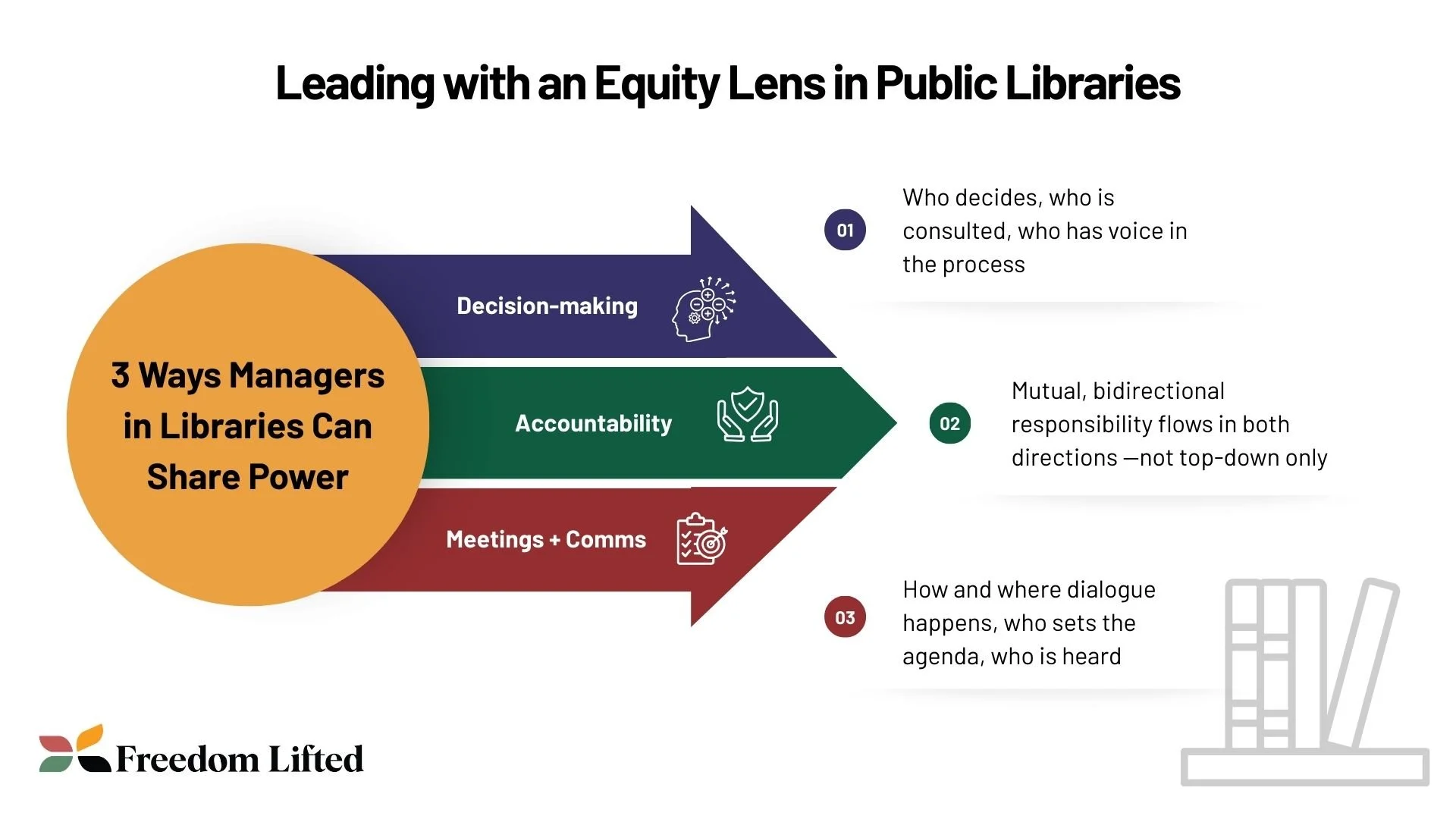
Three Levers for Transformative Management in Libraries
1. Decision-Making
In library systems, the gap between central administration and branch-level reality can be significant. Policies get made at the top, but it's frontline staff who navigate what those policies actually mean for the people walking through the door every day.
Shared power in decision-making doesn't mean everyone votes on everything — it means being intentional about when a manager leads with staff input, when a staff member leads with manager input, and when staff have full ownership of a decision.
We also believe that leadership is fundamentally about making decisions. If we want to develop people as leaders (and most library systems have this priority) we have to actually give them the opportunity to do that.
2. Accountability
Accountability in libraries often gets tangled up with institutional bureaucracy (performance review cycles, HR processes, union agreements) in ways that can make it feel like something that happens to staff rather than with them.
We believe accountability works best when it's built proactively through clear expectations, connecting individual contributions to the library's mission, and using success as fuel. When something does go wrong, a shared power approach asks first about barriers and support — not just performance.
3. Meetings and Communications
How supervisors structure their time with staff (what topics get a meeting, how often, what gets communicated, and why) sends a constant signal about how much we value staff's time, growth, and goals. In systems where branch supervisors may be the primary (or only) consistent leadership presence that front-line staff interact with, this matters even more. Intentional, consistent communication is one of the most underutilized tools in a library supervisor's toolkit.
Training Built for Library Supervisors and Middle Managers
Shared Power in Supervision is a training designed specifically for supervisors and middle managers in public libraries — people who care deeply about their communities and their teams who are ready for leadership tools that actually match their values.
The training is co-facilitated by Mia Henry, founder of Freedom Lifted, and JoLyn Riesdorf, a leader at Tacoma Public Library who brings direct experience navigating the realities of library supervision from the inside. You won't be learning just theory — you'll be learning alongside someone who has lived the work.
If you're ready to lead in a way that reflects what libraries actually stand for, we'd love to have you join us. Register for our next live-virtual session right here.