
Does Your Management Style Reflect Your Commitment to Equity?
The Case for Power Abundance in Nonprofit Management
Most of us who work in nonprofits didn't get into this sector to boss people around. We landed here because we believe in something — a community, a cause, a vision of a just world.
The work of social change is meaningful, urgent, and often relentless. And the people doing it (especially those in the middle who supervise teams while also answering to organizational leadership) carry a lot.
In her book Leading for Justice, Rita Sever says something similar: Middle managers often feel squeezed from both directions.

(Person above attempting to change the world through emails.)
They're trying to be supportive of their staff while also being responsive to their own supervisors. They're expected to delegate to their teams while making sure they don't overload individual people. Add to that the emotional weight of social change work — the under-resourcing, the urgency, the stakes — and it's no wonder that even the most values-driven leaders sometimes fall back on management habits that don't reflect who they are or what they're fighting for.
Somewhere along the way, many of us inherited a model of management that feels more like oversight than partnership. And there's a reason for that: Traditional management is built on the foundational assumption that power is scarce. This predicates the ideas that if a manager gives away authority, they lose it and if staff have too much autonomy, things fall apart.This kind of accountability requires control.
Equity means that a person's identity does not determine how much power they have — their power to be heard, to make choices, to be visible, or to be safe. Traditional management models, left unexamined, can quietly undermine that commitment. The same hierarchies and control structures our organizations work to dismantle in the world can take root inside our own teams.
At Freedom Lifted, we think this assumption of power scarcity is wrong. More than that, we think the unexamined assumption that ‘power is scarce’ is getting in the way of the work we do to shift power within our communities and throughout the United States.
Power Abundance vs. Power Scarcity
Shared Power in Supervision starts with a different premise: Power is not scarce, because it's not a fixed resource. When managers share decision-making, extend genuine trust, and build real accountability with their teams (rather than dictate to and over them), power doesn't diminish — it multiplies.
We call this a power abundance mindset, and it sits at the heart of what we mean by shared power. It’s also the heart of transformative management.
Shared power is NOT about managers stepping back or abdicating responsibility. It's about recognizing that the people closest to the work often have the clearest view of what's needed — and that building their capacity and agency makes the whole organization stronger.
This is a shift in philosophy that changes everything about how we manage teams. In our training, we focus on three key levers where that shift can actually happen.
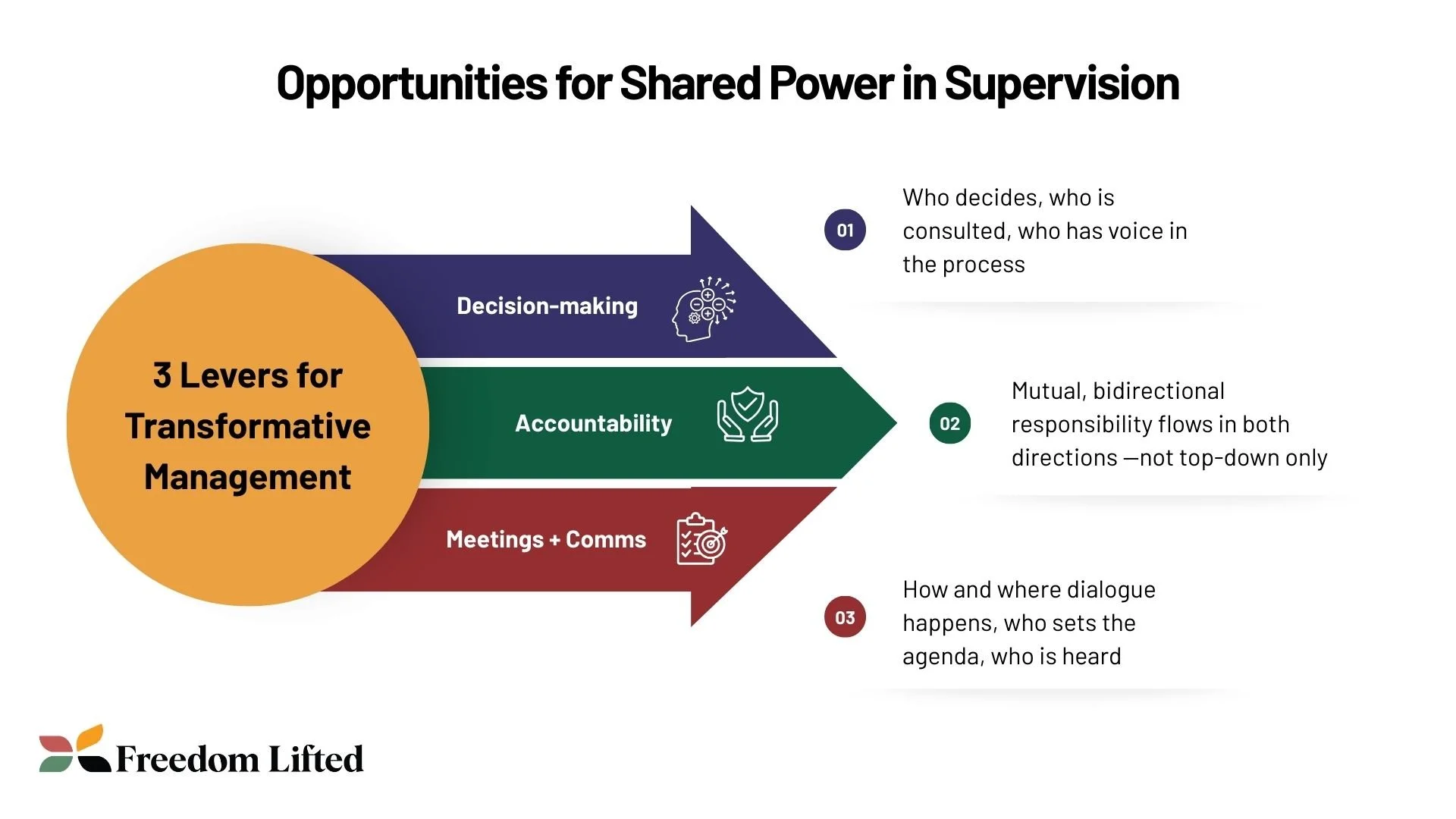
Three Levers for Transformative Management in Nonprofits
1. Decision-Making
Who makes decisions for the organization? How are decisions made and finalized? These questions are at the core of how power moves (or doesn't move) within an organization. Shared power in decision-making doesn't mean everyone votes on everything — it means that the organization (and leadership team) has chosen to be intentional about when a manager leads with staff input, when a staff member leads with manager input, and when staff have full ownership. Getting clear on these distinctions is one of the most powerful things a manager can do for the team and the organization.
At Freedom Lifted, we believe that leadership is fundamentally about making decisions. If we want to develop people as leaders (and most of us in this sector at least say we do) we have to actually give team members the opportunity to do that.
2. Accountability
Accountability often gets conflated with punishment, as if holding someone accountable means waiting for them to fall short – and then responding. At Freedom Lifted, we believe that accountability works best when it's built proactively through clear expectations and by connecting individual contributions to the larger mission. This is the success we can use to fuel our organizational missions.
When something does go wrong, a shared power approach asks first about any barriers that prevent success and any support that might be necessary to improve accountability to the work (not just performance).
3. Meetings and Communications
How managers structure their interactions with staff (i.e. what topics get a meeting, how often meetings will be scheduled, what gets communicated, and why) sends a constant signal about whether we value our staff's time, growth, and goals.
Intentional, consistent communication is one of the most underutilized tools in a manager's toolkit. Further, the way we talk with and engage one another is foundational to organizational culture. One of my favorite aspects of our Shared Power in Supervision training is covering both boundaries and the nuts and bolts of team communications.
Ready to Go Deeper?
These three levers are just the starting point to developing internal organizational commitments to power abundance. In our Shared Power in Supervision training, we work with nonprofit managers and leaders to move from intellectual concepts to practical application — with real scenarios, honest reflection, and tools that can be implemented within the same week.
If this resonates and you want to explore what this could look like for your team, we invite you to join us in our next Live-Virtual Shared Power in Supervision training or book a possibility call with our team to see how we can bring this training to your organization. We'd love to talk.