
Is It Feedback…Or Just Criticism?
A Distinction That Matters for Anyone Showing Up in Leadership Rooted in Equity
We've done a lot of good work in recent years to strengthen our organizations. Many of us have opened space and created opportunities for more voices, more honesty, and more accountability. People who were once expected to stay quiet are speaking up. Staff are naming what isn't working. Leaders are being asked to be more transparent, more accessible, and more human. That's progress worth protecting.
However, in the past month, I’ve had conversations with three different clients about how a culture of constant criticism is lowering morale, silencing ideas, and undermining trust in their organizations.
I fear that in creating the space for people to speak, we missed important lessons on how to speak well to each other — across differences and with consideration for our various forms of power.
“Although we struggle for freedom and democracy, we also suffer from tendencies toward abuse and domination.” – Maurice Mitchell, Building Resilient Organizations: Toward Joy and Durable Power in a Time of Crisis
I find that these tendencies Maurice Mitchell refers to are often seeded in how we communicate with one another. There’s a frustrating disconnect between our fight for more voice and visibility in the public sphere and how we see and hear each other within our organizations. And this is showing up in ways that are undermining the very cultures we're trying to build.
Part of what's feeding this disconnection is the communication we're absorbing from the world around us. Social media rewards hot takes over nuance. Politicians model insults and ‘gotcha’ moments as a form of engagement. Reality television thrives on drama, conflict, and humiliation. These are the prevalent cultural templates for how we talk to each other right now; and whether we realize it or not, this is a large part of what’s shaping how we show up in our communities, too.
It's no surprise, then, that we're seeing a misguided conflation of two things that are very different: Feedback and criticism. This confusion is doing real damage to our work for equity and justice.
Feedback v. Criticism: What’s The Difference?
Here's the distinction I want to make up front (because everything else in this piece hangs on it):
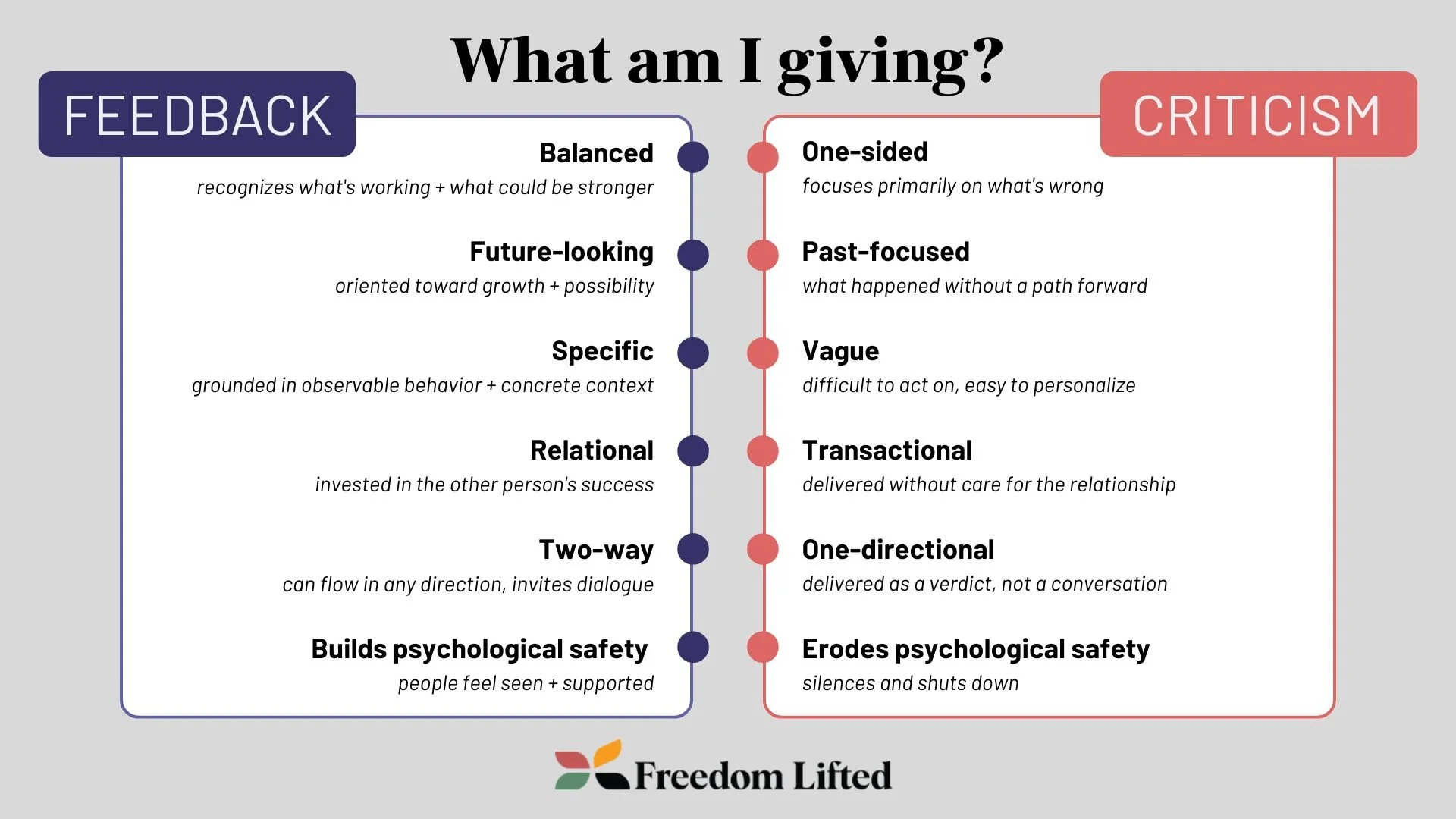
Feedback is balanced, specific, forward-looking, and relational. It acknowledges what's working and what could be stronger. It's offered in the spirit of someone's growth, and it can flow in any direction — peer to peer, staff to manager, manager to staff. Feedback is something you give to someone you're rooting for.
Criticism tends to be one-directional, focused on what's wrong, and rooted in the past. It tells people what they did poorly without offering much about what to do next. It often arrives without context, without care, and without any accompanying recognition of what's going well.
Often the sources of criticism (disguised as feedback) are directly related to the “Common Trends” that Mitchell lays out in his article — especially Anti-Leadership Attitudes, Disproportionality, and The Small War. We feel a short-term sense of power when we question leadership. We draw false equivalances between oppression and being asked to do work. And when we get pushback on our grievances, we say folks simply can’t take feedback.
But the problem isn't that people can't take feedback. The problem is that what's being delivered often isn't feedback at all. When we feel bombarded by criticism and starved of genuine recognition, we don't become more open — we become more guarded.
That’s often when everything starts breaking down.
This isn’t to say criticism has no place. There are moments when it's needed — when someone or a group is causing genuine harm, acting unjustly, or behaving in ways that need to be named directly and stopped. Criticism can be an act of accountability. But when people are working toward a common goal, genuinely trying, and wanting each other to succeed — that's not a situation that requires criticism. That's a feedback opportunity. Treating it like the former when it calls for the latter can do real damage.
This matters for anyone who is trying to show up through leadership — and I mean that broadly.
Leadership isn't just a title. Leadership is a posture. It's the choice to engage with others in ways that orient toward something better. This includes managers giving feedback to staff, yes. But it also includes staff offering feedback to managers, peers holding each other accountable, and teams navigating hard conversations across all kinds of differences in role, identity, and power. The distinction between feedback and criticism is relevant to all of it.
Most People Are Doing Most Things Well
Let's start here, because I think it matters: Most people, most of the time, are doing most things well. That's not a soft take; it's the reality of most workplaces. And yet our feedback cultures often behave as if the opposite is true, surfacing problems while letting good work pass unacknowledged.
Research from Gallup finds that employees who receive regular recognition are significantly more engaged — and far more likely to experience feedback itself as valuable. My experience has taught me that when recognition consistently outweighs criticism, people have a stronger foundation for hearing the harder stuff. When it doesn't, every piece of corrective input lands on already-depleted ground.
This matters strategically and neurologically. As humans, we are wired to seek pleasure and to register threats. Negative feedback activates our threat response. Positive feedback doesn't. That's not a character flaw; that's biology.
This means it's on the feedback giver (not just the receiver) to account for that reality. And it's a good reason to be intentional about balance, regardless of which direction feedback is flowing.
The Science (and Heart) Behind Good Feedback
Good Feedback Is Ongoing and Two-Way
One of the most common mistakes organizations make is treating feedback as a formal, periodic event — the annual review or the end-of-project debrief. But real feedback culture is continuous. It happens in small moments, in passing, and in regular check-ins. It happens when something goes well, not just when something goes sideways.
Equally important: Feedback should be a genuinely two-way interaction. That means managers receiving feedback from staff, peers offering feedback to peers, and everyone developing the capacity to both give and receive feedback across differences in power and position.
This is, at its core, a shared power practice. Who gets to speak, who gets heard, and whose observations are treated as valid are all power questions. When we're serious about distributing power in our organizations, that has to include the power to name what's working and what isn't — in any direction.
When feedback only flows in one direction (or when the expectation of openness runs only one way), it stops functioning as a tool for growth and starts functioning as something else entirely.
Good Feedback is Future-Looking
Author Daniel Pink argues that the most effective feedback is forward-facing — focused not on what happened, but on what's possible. "How can you do it better next time?" lands differently than "Here's what you did wrong." One opens a door. The other closes a case.
This is why criticism so often falls flat: It's retrospective. It describes the problem without illuminating the path forward. It leaves people with a verdict but no map, whether that criticism is coming from a manager or from a staff member who's frustrated with how things are being led.
Good Feedback is Thoughtful
There are two models of sharing feedback that we at Freedom Lifted recommend to people who really want to be thoughtful about their approach to feedback.
The SBI Method: A Framework for Both Positive and Negative Feedback
The Center for Creative Leadership (CCL) offers a powerful framework called SBI (Situation, Behavior, Impact) that works equally well for positive and corrective feedback. Too often, people think of models like this as tools for difficult conversations only, but SBI is just as useful for recognition.
Situation: Set the specific context. ("In yesterday's staff meeting...")
Behavior: Name the observable behavior, not an interpretation or judgment. ("When you paused and asked the room what they were noticing before moving to the next agenda item...")
Impact: Describe the actual effect. ("It shifted the energy in the room. People leaned in. I think a lot of us felt genuinely heard.")
That's feedback: It's specific. It's grounded in observable reality. It tells the person what they did and why it mattered, and it works just as powerfully when the impact is positive as when it isn’t. It also works in any direction. The framework doesn't care about hierarchy — it cares about honesty and specificity.
The BIRCH Method: When a Change Is Needed
When feedback involves an expected change in behavior, the BIRCH method created by Nash Consulting provides additional structure:
Behavior: What specific behavior are you addressing?
Impact: What has been the effect of that behavior?
Request: What change are you asking for?
Consequence: What will happen if the change occurs — or doesn't?
Hope: What do you want for this person and for the relationship?
That last element (hope) is not an afterthought. It's the reminder that feedback given well is an act of investment.
You're not delivering a verdict. You're expressing belief in someone's capacity to grow. That's true whether you're a manager asking a staff member to shift their approach or a staff member asking a manager to lead differently.
(Thanks to my colleague JoLyn Reisdorf of Tacoma Public Library who introduced me to this fantastic resource.)
The Intent-Impact Gap
Here's something I see often: Someone gives feedback with genuinely good intentions, and it still lands hard. The giver is confused or feels bad. The receiver is hurt. They both walk away feeling misunderstood.
This is the intent-impact gap. This is the space between what you meant and what the other person experienced. Good intentions don't close that gap on their own. Impact is real, regardless of intent.
And the goal isn't to assign blame on either side. The goal is to bridge the gap — to build enough mutual understanding that the giver can see how their feedback landed and the receiver can understand what the giver was trying to offer.
That bridging requires humility from both directions. It requires the giver to stay curious after they've spoken and the receiver to stay open to the possibility that something was genuinely meant with good intentions, even when it didn't feel that way.
Trust Is a Precondition
I always say that it's easiest to take feedback from people you know are in your corner.
When trust exists between two people, feedback can be offered imperfectly and still land with grace. The receiver knows there's goodwill behind the words, so they can hear through the awkwardness to what's actually being offered. When trust is absent, even the most carefully structured feedback can feel like an attack. Remember: People are often reading the relationship as much as they're reading the words.
This is why we often invoke refrains such as “Think Well of Each Other” or “Move at the Speed of Trust” (popularized by adrienne maree brown’s Emergent Strategy). When we include phrases like this in our group agreements, I’d argue that we are priming ourselves with the ability to give and receive feedback.
This is worth sitting with if you're someone who finds that your feedback (in any direction) consistently lands poorly. The question worth asking isn't "Why can't they take feedback?" Rather, it's "Given our relationship, what might they expect from this conversation?"
Psychological Safety Runs In Many Directions
When criticism replaces feedback as the dominant mode of a workplace (regardless of where it's coming from) something corrosive happens to the culture. People stop taking risks. They stop sharing unfinished ideas. They stop admitting mistakes early when something can still be fixed. They start managing impressions instead of doing their best work.
This is the erosion of what researcher Amy Edmondson has coined psychological safety — the shared belief that a team is safe for interpersonal risk-taking.
It's worth noting that psychological safety isn't only something managers owe their staff. It's something everyone in a workplace contributes to or erodes by how we speak to each other, how we handle disagreement, and whether we extend the same care in our feedback that we hope to receive in kind.
I’ve seen peers who don’t have positional power over one another still impact each other’s psychological safety. We become afraid of our own colleagues, because those folks can ‘ice us out’ if we don’t agree with them. They can make our jobs harder if we don’t side with them in what the Conscious Leadership Group talks about as the drama triangle at work..
Several clients have raised this with me recently, describing organizations where people are walking on eggshells — not because leadership is authoritarian, but because criticism has become normalized at every level and no one feels like they can simply do their best work without bracing for the next round of it.
The answer, though, isn't to shut down honest conversation. It's to raise the quality of it.
Advice for Feedback Givers
If you're in a position to give feedback — and if you're showing up through leadership in any direction, you are — here's what I'd invite you to hold:
Balance positive and corrective. Don't wait for something to go wrong before you speak up. Notice what's going well — not just the big wins; the small ones, too: The meeting someone facilitated with care. The decision handled with transparency. When people hear from you regularly about what's working, they're in a far better position to hear what isn't.
Be specific. Vague feedback is hard to act on and easy to personalize. "You need to communicate better" gives someone nothing to work with. "In the last two team meetings, when you shared updates, I noticed there wasn't any space for questions. I think people left uncertain about next steps" gives them something real.
Be future-forward. Focus less on what went wrong and more on what you want to see. What does ‘good’ look like from here?
Mind the timing. Feedback is most useful when it's close in time to the situation it addresses. Holding things for weeks (or raising them in a formal setting long after the moment has passed) means that the person may not even remember the context you're referencing. What could have been a learning conversation becomes a grievance delivery.
Get grounded before you give feedback. Feedback delivered from frustration, exhaustion, or a place of accumulated resentment tends to land as an attack, even when it's accurate. Take a breath. Get clear on what you actually want for this person and this relationship. Lead from that place.
Mind the intent-impact gap. After you've given feedback, stay curious about how it landed. "How did that come across for you?" is one of the most generous questions a feedback giver can ask – depending on the situation and your relationship.
PAUSE: Take a minute right now to consider which one piece of advice you might like to put into effect in your workplace.
Advice for Feedback Receivers
Receiving feedback is its own skill — one that deserves as much attention as giving it.
Consider the source.Not all feedback carries equal weight. Before you internalize something, ask yourself: Is this person in my corner? Do they have the context to see my work clearly? Are they invested in my growth? Feedback from someone who's genuinely pulling for you deserves to be taken seriously, even when it stings. Feedback from someone who isn't pulling for you doesn't need to be dismissed — but it also doesn't need to live rent-free in your head.
Learn to discern. Discernment is different from dismissal. Even feedback delivered poorly or from a complicated source may contain something worth your examination. The skill required here is to learn how to separate the message from the messenger — to hold the feedback up to the light and ask: Is there something true here, even if the delivery wasn't great? It’s neither defensive rejection nor uncritical acceptance.
Ask questions.You are allowed to ask for more information. If feedback is vague, ask for specifics: "Can you give me an example of what you're describing?" If it's past-focused, ask about the future: "What would you want to see instead?" These aren't defensive moves; they're ways of turning a criticism into a conversation. This is especially important when feedback is negative: The more specific you can get about context and expectations moving forward, the more useful it becomes.
Don't sit in it alone.If you're receiving feedback that feels overwhelming or hard to interpret, talk it through with someone you trust. A thought partner can help you separate what's worth taking in from what isn't. I recently helped a close friend work through a less than stellar performance review at work — we don’t have to do the hard stuff all on our own.
PAUSE: Consider which of these might be most beneficial to you the next time you receive feedback (positive or negative).
A Final Word
We are living in a moment when the dominant models for how we treat and talk to each other are not serving us well. Hot takes, political theater, and manufactured conflict are teaching people that being sharp is the same as being honest, volume is the same as truth, and calling someone out is the same as holding them accountable.
But none of this is true.
Feedback done well is one of the most generous things one human being can offer another. It says: I see you. I believe in what you're capable of. I care enough to be honest with you.
This kind of feedback requires something from the giver — trust-building, balance, specificity, and a genuine orientation toward the other person's growth. It requires something from the receiver too — curiosity, discernment, and the willingness to stay open even, when something lands hard.
This is what shared power actually looks like in practice. Not just who gets a seat at the table, but how people treat each other once they're there. Feedback — real feedback that’s balanced, specific, and forward-looking — is one of the most concrete ways we either live out our commitment to shared power or abandon it in the small moments that add up to culture.
We've worked hard to create space for more voices in our organizations. Now the invitation is to help each other use those voices well.Our organizations and the people in them deserve that. And the viability of our work depends on it.