
What people remember about great bosses, and what shared power has to do with it
Every Shared Power in Supervision training Freedom Lifted hosts begins with a question that has nothing to do with frameworks.
I ask people to think of a great manager, supervisor, coach, or teacher they have had – not a perfect one; just someone who made the work better… or made them better at it.
Then I ask two questions:
What did that person do?
How did that person make you feel?
In the past month alone, about 65 people have shared their answers with me via polls and post-its. Here is what they think about what great supervisors do, what they make us feel, and what they know.
What Great Supervisors Do: Accountability, Support & Feedback
In the answers I received, words like "communication" and "accountability" came up again and again – right alongside "supportive." Importantly: None of the participants saw these as opposites.
The more detailed answers are even more helpful: “A good supervisor or boss… Communicates the why; offers an invitation, not a directive; creates a safe space for failure; prioritizes growth instead of shame, and demonstrates sincere curiosity.”
Great supervisors also ask for feedback: "Open to feedback" and "honest and humble" were both on the list, too: “A good supervisor or boss… asks for feedback, even when the answer might be critical, and they receive that feedback as a gift.” This models humility and also shows everyone else on the team how to give and receive feedback, whether positive or negative.
A Framework Emerges
I have been asking this question for years, and every set of responses has informed the ‘why’ behind our training framework to focus on these three important levers: decision-making, accountability, and meetings and communications.
The words people chose (this month alone) fit them closely. On decision-making, they wrote "lets you make decisions," "gives ownership," and "autonomy." On accountability, they wrote "accountability" and "follow through." On meetings and communications, they wrote "communicating the why," "clarity," and "checks in."
Great supervisors do not pick just one lever. They use all three, and they use them with each person in mind. Read more about the three levers in “Does Your Management Style Reflect Your Commitment to Equity?”
What Great Supervisors Make Us Feel: Powerful
In one recent Shared Power in Supervision session, "empowered" was the most commonly used word, followed by "valued," "capable," and "confident." Other great supervisors were quieter: “They made me feel… like a person, not a number; safe to be human; free to be imperfect; supported when uncertain; protected; and resourced."
Nobody described a supervisor who held all the power. They described someone who made them feel powerful.
Different Complaints, Same Gap
Within our training sessions, we also ask about the supervisors people do not remember fondly. Some participants describe these unhelpful supervisors as micromanaging. Others say their least favorite bosses are not hands on enough.
These sound like opposite complaints, but they’re not really. Both describe someone who did not notice when their direct report needed to feel seen, heard, and resourced. One person needs a weekly conversation about priorities; another needs to be trusted with a project for a month. A supervisor who gives both people the same thing will fail one of them. Rather, their responsibility is to understand and be responsive to the people they supervise.
Great supervisors are adept at calibrating their supervisory style for each person. What they do not calibrate, though, is accountability: Everyone is held to the same standard, and everyone can count on the same follow-through.
What Great Supervisors Know
This is where we look at supervision through a shared power lens.
In Shared Power in Supervision, building shared power into the workplace means that managers make an ongoing, concerted effort to make sure everyone, regardless of identity and role: 1) is resourced, 2) is seen, 3) is heard, 4) has agency, and 5) is safe.
Supervisors who share power know a few things about themselves:
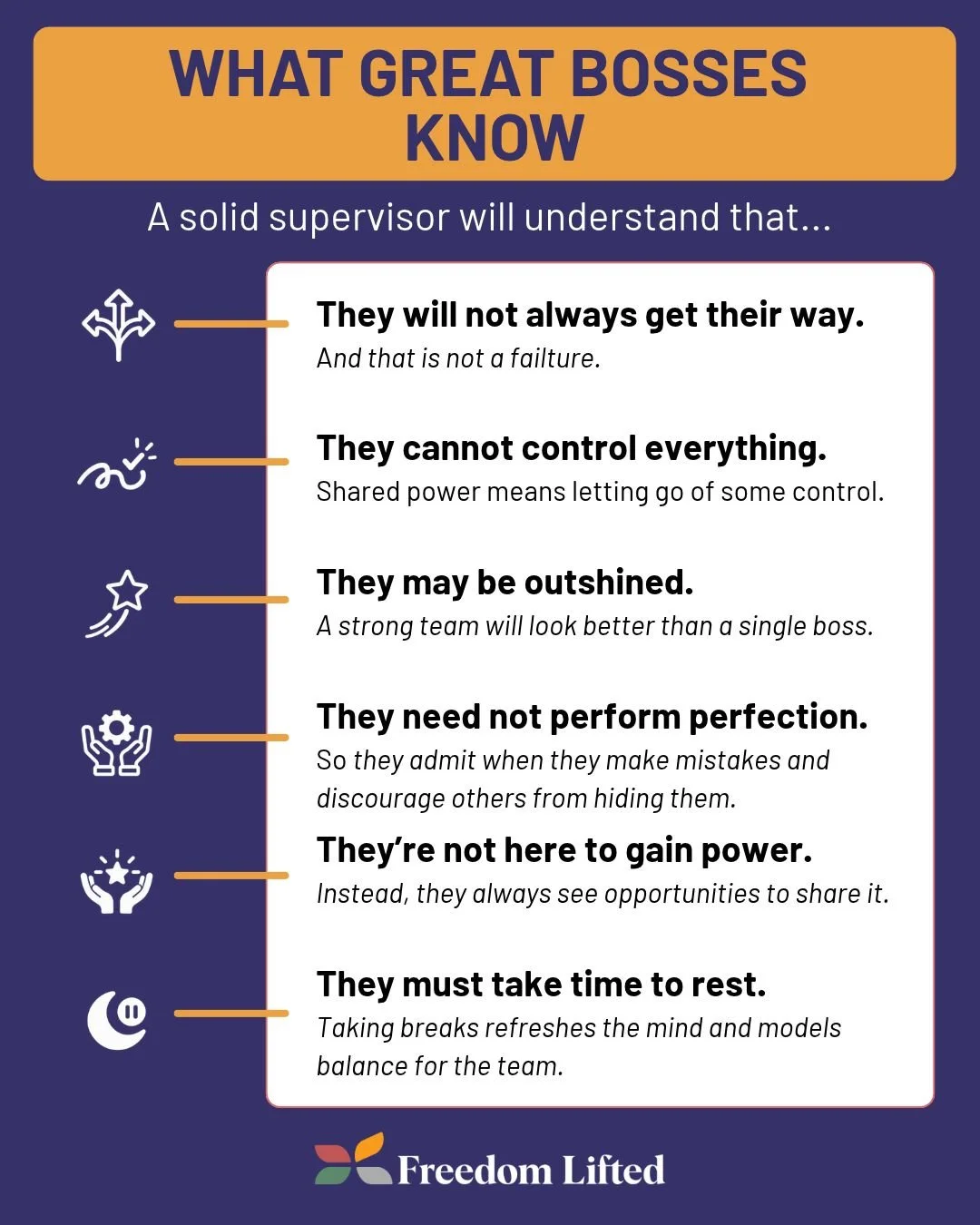
They know they will not always get their own way. If we share decision-making and act on the recommendations from those closest to the work, a supervisor might find themselves implementing an idea that is not their own. Great bosses trust their staff to sometimes lead the way.
They know they cannot control everything in the workplace. Micromanaging is a top complaint of employees about their supervisors. Staff must own their own work in order to grow in their leadership.
They know they may be outshined by those who report to them. The goal of a supervisor is to help direct reports be successful at their jobs. Therefore, a great team should shine brighter than a single boss.
They know they do not need to strive for perfection or “perform” it. They can admit when they’ve made a mistake. (A supervisor who performs perfection teaches everyone else to hide their mistakes, (and "free to be imperfect" was not written by any of the respondents.anyone who worked for someone performing perfection.)
They know when to rest, and they model taking breaks. (A supervisor who never stops is likely not operating at their best and teaches the team the path to burnout, not balance.)
They know their job is not to increase their own power but to make the people who report to them more powerful – to actively share power in the workplace.
We at Freedom Lifted believe the role of a supervisor is to share power through the whole organizational team, because feeling and being powerful is what makes people successful in the work they do.
I invite you to look back at the words people chose to describe how a great boss or supervisor makes them feel: Resourced. Well-equipped. Seen. Heard. Empowered. Autonomous. Protected. Secure. Safe to be human.
The people in our training wrote these before we ever named the framework – and yet they describe shared power quite accurately. This is what power feels like from the inside, when leadership has made room for it.
Interested in being someone’s next great manager? Curious about how you can intentionally share power in your workplace? Learn more about our next Shared Power in Supervision online training.